How to Run a Community Co-design Workshop That Leads to Action
A practical guide to sharing decisions, making participation accessible, testing ideas together, and turning a community workshop into a clear next step
October 20, 2026
•7 min read

A community workshop can produce a lively conversation and leave everyone uncertain about what happens next. People contribute their time, organizers collect ideas, and the resulting notes wait for someone to turn them into a decision.
Co-design asks for a different arrangement. People affected by a service or activity help define the problem, develop possibilities, and shape what gets tried. That requires shared influence before the meeting and continued involvement afterward. One workshop is a working session within that relationship.
A useful session should leave participants with a clearer understanding of the problem, something concrete to examine, and an agreed next step. The following approach suits a small community initiative that has room to change and someone responsible for carrying the work forward.
Define the Decision Before Sending Invitations
Write down what participants can influence. “Help us improve the community center” is too open to guide a single session. “Help us design how newcomers find and join activities” gives the group something it can work on.
Explain the constraints, available resources, and decision process. Can the group choose a small trial? Does a committee need to approve spending? Which parts of the service are fixed, and which assumptions can be challenged?
Agree these boundaries with community partners rather than presenting a finished brief. The principle behind community participation that shapes civic technology applies here: people need to understand how their contribution can change the outcome.
If the main decision has already been made, describe the session accurately as feedback or consultation. Calling it co-design will not create influence that the organizers cannot share.
Invite People With Different Experiences
Include people who use the activity, people who tried and stopped, and people who encounter barriers before they arrive. Staff and volunteers bring operational knowledge, but they cannot stand in for every resident's experience.
Work through trusted local contacts as well as an open invitation. Ask whom the recruitment approach is likely to miss. One familiar committee or online group may offer valuable knowledge while leaving other perspectives unheard.
Have a short conversation with prospective participants about the purpose, activities, and support available. Explain any payment or expense arrangements before they agree to attend. Budget for the work of participation, including preparation and follow-up.
A small workshop cannot represent an entire neighborhood. Record whose experience is missing and arrange other ways to hear it. Do not describe the people in the room as speaking for everyone who shares their age, language, or circumstances.
Design Access Into the Session
Choose the venue, timing, and methods with participants. Check the entrance, toilets, seating, transport options, noise, lighting, and space for moving between activities. Share specific access information and a contact for discussing requirements.
Offer materials in suitable formats, use plain language, and arrange interpretation or communication support where needed. Include breaks and a quiet place. Give people permission to pass on an activity or contribute privately.
Avoid making fast handwriting, standing at a wall, or using a particular device a condition of participation. Someone might prefer to speak, draw, dictate to a helper, or contribute through a supported conversation. The guide to digital inclusion beyond an internet connection is useful when planning any online contribution route.
Keep remote or later contributions connected to the same decisions. Simply opening a video call does not ensure that people joining remotely can hear, see, or influence the work.
Start With Experience Before Asking for Solutions
At the opening, explain the purpose, decision boundaries, agenda, and follow-up arrangements. Agree how people will take turns, challenge ideas respectfully, and handle personal information. Introduce the facilitator's role and a separate person responsible for notes.
Use a concrete prompt. For a hypothetical community center project, ask participants to describe the steps involved in joining an activity: hearing about it, finding information, making contact, arriving, and deciding whether to return.
Let people share only what they choose. A difficult experience can be described without naming another person or disclosing private circumstances. Do not promise confidentiality that a group setting cannot guarantee.
Check your interpretation with the speaker. “Was the difficulty finding a contact, or getting an answer?” is more useful than immediately translating the story into a preferred solution. Keep different experiences visible even when they do not fit one neat journey.
Give Everyone Space to Develop Ideas

Offer a short period of individual reflection before group discussion. Participants can think about what would make one difficult step easier without having to respond to the first confident suggestion.
Invite contributions in turn, with an option to pass. Ask for clarification before evaluation. The facilitator should notice when staff explanations, professional language, or repeated interruptions are narrowing the discussion.
Separate the need from the proposed response. A participant suggesting a new app may be asking for reliable information. Someone requesting a staffed desk may want reassurance before entering an unfamiliar space. Keeping the need visible allows several possible responses to be explored.
Use agreed criteria to compare ideas: usefulness to the intended participants, access, staffing, cost, and what the team could learn from a trial. A quick vote can indicate interest, but ask who might be excluded by the popular option. Preserve unresolved concerns rather than recording silence as agreement.
Make One Idea Concrete Enough to Examine
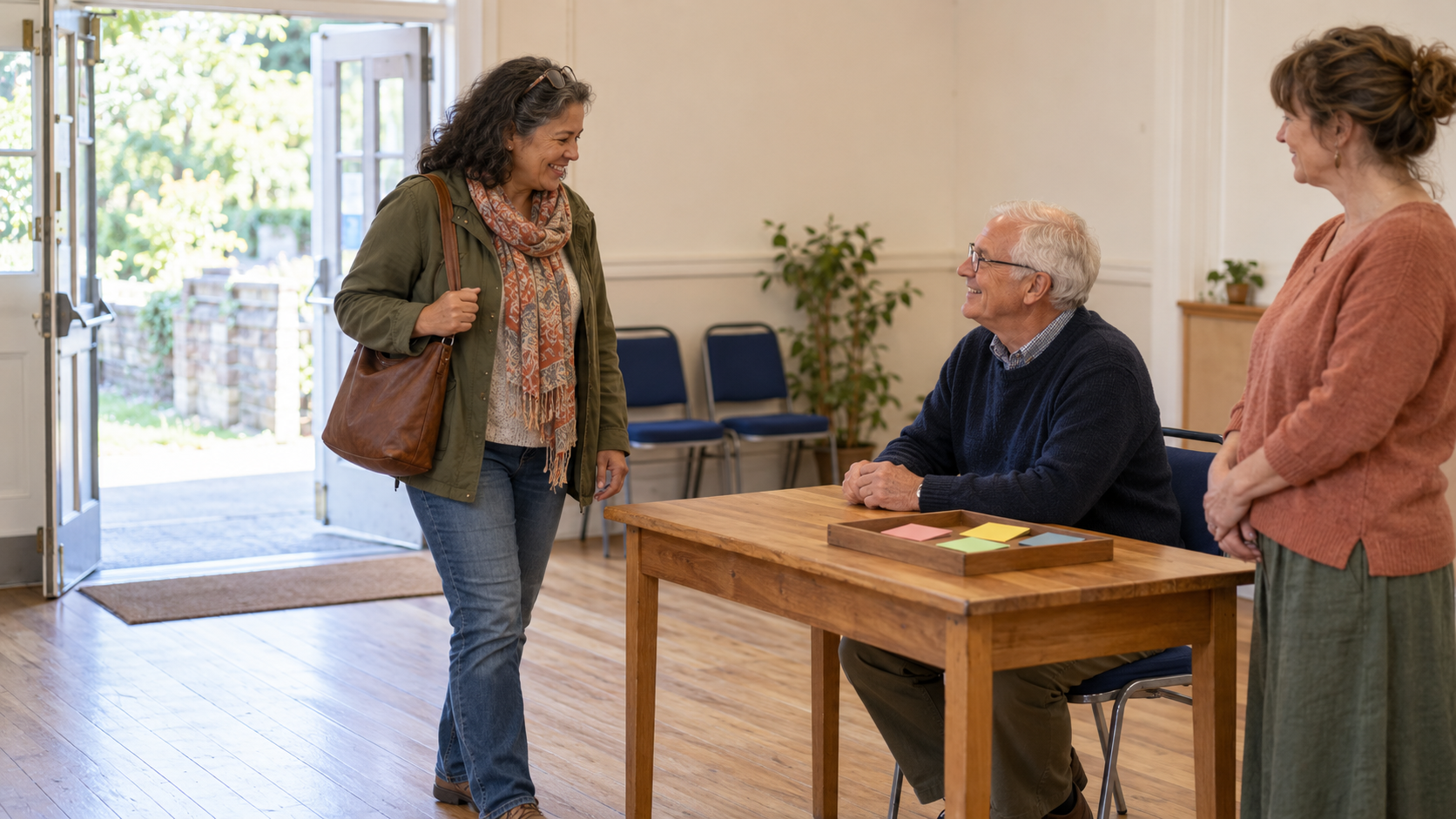
Choose something the group can make tangible. A prototype might be a paper invitation, a rearranged welcome area, a sequence of appointment steps, or a rehearsal of a conversation. It only needs enough detail to explore a question.
For the community center example, participants could rehearse what happens when a newcomer arrives without knowing which activity to join. One person plays the visitor, another the volunteer, and an observer notes where information or reassurance is missing. Make clear that this is a hypothetical rehearsal, not evidence of how all visitors behave.
Try a different version. What changes if nobody is at the desk? How would someone who prefers not to explain their circumstances find the same information? Let participants alter the arrangement themselves.
Separate what was observed from what the team assumes. A successful rehearsal suggests something worth testing; it does not establish that the service will work in everyday conditions. Keep the prototype easy to change.
Agree a Small Test and Its Responsibilities
Before closing, turn the chosen idea into a short test plan. Record:
- Question: What uncertainty should the test help resolve?
- Change: What will happen differently, where, and for how long?
- People: Who will take part, and what support will they receive?
- Ownership: Who arranges the test and secures any required approval?
- Evidence: What will be observed, and how can participants give feedback?
- Review: When will the group consider whether to adapt, continue, or stop?
For example, the center might trial a different welcome arrangement during a limited set of activities. The question could be whether newcomers can identify their next step without repeated explanations. Agree who will notice difficulties and what happens if the arrangement causes confusion.
Keep the scope within the team's authority and capacity. If approval is outstanding, name the person seeking it and when participants will hear the result. An idea awaiting permission is not yet an agreed service change.
Return the Decisions to Participants
Send a brief account in the formats people requested. Include the problem explored, options considered, concerns retained, decisions made, and owners of the next actions. Let participants correct misunderstandings before their contributions become a public account.
Ask separately before sharing names, quotations, photographs, or identifiable stories. A photograph of workshop notes can expose personal information even when no faces appear. Keep private coordination details apart from material approved for wider circulation.
Invite participants to help interpret the test results and revise the idea. The approach to measuring social innovation through community outcomes helps distinguish a completed workshop from an improvement people experience.
If the work stalls, explain why and what remains possible. Co-design depends on a visible connection between people's effort and the decisions that follow. A modest test with clear ownership gives the group a practical basis for continuing that work together.
Images are AI-generated illustrations of community workshop activities and a service rehearsal.